It is one week until Colorado's Dragon Boat Festival. This year the Consul-General of Japan will be there. I was invited to take part in a cosplay event (cosplay is costuming to themes of literature, tv, cinema, and manga art).
For those readers new to my blogs I run 2 blogs one on Geography and one on Costuming. For the next 2 weeks I have the boon to discuss both together. So both blogs will be sharing about Colorado's Dragon Boat Festival. For those interested in costumes I will be showing off my favorites of the event and a little bit about the participants. For those interested in Geography I will be discussing the influence of Asian Cultures in the Pikes Peak Region. So after this initial post each blog will have a different topic, Visit my other blog here http://eyesoncolorado.blogspot.com
To start off the week:
The rich diversity of cultures in the Colorado region allows Americans and tourist to take part in many cultural events. One such event on July 30th is the Dragon Boat Festival held at Sloan Lake Park in Denver Colorado. For information about the event and directions for parking please follow this link http://www.cdbf.org/
The Dragon Boat Festival (or Duanwu festival) is a holiday originating in China and is associated with a number of Asian cultures today. It is held the 5th day of the 5th month (June 6th in the US traditionally), Denver Colorado Celebrates it on July 30th this 2011.
" The best-known traditional story holds that the festival commemorates the death of poet Qu Yuan (Chinese: 屈原) (c. 340 BCE – 278 BCE) of the ancient state of Chu, in the Warring States Period of the Zhou Dynasty. A descendant of the Chu royal house, Qu served in high offices. However, when the king decided to ally with the increasingly powerful state of Qin, Qu was banished for opposing the alliance. Qu Yuan was accused of treason. During his exile, Qu Yuan wrote a great deal of poetry, for which he is now remembered. Twenty-eight years later, Qin conquered the capital of Chu. In despair, Qu Yuan committed suicide by drowning himself in the Miluo River on the fifth day of the fifth lunar month.
It is said that the local people, who admired him, threw lumps of rice into the river to feed the fish so that they would not eat Qu Yuan's body. This is said to be the origin of zongzi. The local people were also said to have paddled out on boats, either to scare the fish away or to retrieve his body. This is said to be the origin of dragon boat racing." ~Wikipedia
http://en.wikipedia.org/wiki/Duanwu_Festival
Well I don't want to spoil to much today so I will post more soon.
Hope you can join us next Saturday July 30th at Sloan Park, Denver Colorado.
The Spanish Peaks

From a Survey of Colorado's Plant Communities
Friday, July 22, 2011

Saturday, July 9, 2011
Water water everywhere but not a drop to drink

Mark Twain once said, "Whisky is for drinking, water is for fighting over".
Ever ponder water and wonder why its so hard for people to get it around the world when it falls from the sky, seeps from the ground, and flows across the land, and when 70% of the world is water?
The simple answer is fresh water is rare and salt water is the majority. It doesn't rain everywhere, some people can not access ground water, damns stop historical rivers and people fight wars over water. Wars over water? Can you imagine having to result in armed conflict to get drinking water or crops irrigated?
For many people in the world this is the case. Water is a big issue world wide. Even people on river and lake systems have conflicts protecting the resources. Here are 4 examples in just 2010 where people died in conflicts over water.
ONE: Fighting in Pakistan over irrigation water
Date: 2010
Parties: Pakistani tribes
Basis: Development dispute; Military tool
Violent: Yes
More than 100 are dead and scores injured following two weeks of tribal fighting in Parachinar in the Kurram region of Pakistan, near the Afghanistan border. The conflict over irrigation water began as the Shalozan Tangi tribe cut off supplies to the Shalozan tribe. Some report that the terrorist group al-Qaida may be involved; others claim sectarian violence is to blame as one group is Sunni Muslim and the other Shiite.
TWO: Bomb in water truck kills 3 in Afghanistan
Date: 2010
Parties: Afghanistan
Basis: Terrorism
Violent: Yes
A remote-controlled bomb hidden in a water truck killed three people, including two children, in eastern Afghan province of Khost, which borders Pakistan.
THREE:Pakistan irrigation dispute kills 116
Date: 2010
Parties: Mangal and Tori tribes, Pakistan
Basis: Development dispute
Violent: Yes
A water dispute in Pakistan
FOUR:Violent water protest in India
Date: 2010
Parties: India
Basis: Development dispute
Violent: Yes
A protest about water shortages leads to violence. Erratic water supply, and eventually a complete cutoff of water in the Kondli area of Mayur Vihar in east Delhi causes a violent protest and several injuries.
Its a historical strategy in warfaer.
Hezekiah stops springs in advance of Assyrian Invasion
Date: 701 BC
Parties: Israel (Judah), Assyria
Basis: Military tool; Military maneuvers
Violent: Yes
When King Hezekiah of Judah sees that Sennacherib of Assyria is coming in war, he has the water from the springs and brook outside Jerusalem stopped to keep the water from the Assyrians.
Furthermore the water conflicts are not that far from home. Even the united states has had water conflicts over riporian water laws and who has rights to use river water. And many times in United States history did enemies of the state target water supplies to disrupt water flow. Luckily most blown damns or blocked rivers are a thing of US past but terrorist foreign and domestic still threaten water supplies.
For example:
Colorado eco-terrorists threaten water supply
Date: 2002
Parties: United States
Basis: Terrorism
Violent: No: Threat
The Earth Liberation Front threatens the water supply for the town of Winter Park. Previously, this group claimed responsibility for the destruction of a ski lodge in Vail, Colorado that threatened lynx habitat.
Thanks to World Water.org I found a nifty map showing the worlds water conflicts where you can interact with it to find out more data.
http://www.worldwater.org/conflict/map/
Their webiste is a handy tool to geographers dealing with water conflicts. By all means it is not a begin all end all resource but its a good start.
If I can impose on anyone who finds this article: Look into local water issues, donate to water conservation efforts or digging wells for the impoverished. Their are many nonprofits that handle this issue. Help where you can even if its telling a friend.
Anyway I will have more on this topic for the next few weeks. For now have a good time and enjoy a cool glass of water while you have it.
Friday, July 1, 2011
What is geography, It's magic!
Often I find myself answering the question "What does a geographer do?" with the witty come back "Everything" to the dismay of friends and family. In the professional sense I tell employers I gather data, where I look for trends in data about location, place, human-environment interaction, movement, and regions and how interact with each other, and that I can show these trends on everything from a map to a bar-graph. Where this is the most specific singular sentence I can use to describe geography, I think Judy Martz said it best as, "Everything has to do with geography."
The modern Geographer needs to know just about everything. This should be evident to the nature of its goals but I will elaborate. Every geographer will have to have at minimum knowledge of, Earth Science, mathematics/statistics, rhetoric, cultural diversity, cartography and navigation. Which gives them the ability to understand and elaborate on data. Modern geographers also should know many tools (computers, compass maps, software, Global Information Systems, geological hammers, microscopes just to name a few). The goal of geography is to make information about the world accessible or useable. This means a geographer is not only using math to prove a fact but also dictating a train of thought about the philosophical argument. Geographers will use law, science, behavior psychology, math, literature, and philosophy to establish concrete data on a subject. This is due to the broad spectrum of data a geographer will use.
For example: A geographer is collecting data about a region to build a new damn in a flooded valley. They will survey, measure and map the selected valley, locate and identify human/animal populations that may need relocating, identify geographic substrata to determine if an area has enough impermeable surface to retain said dam water, they will need compose data to be usable by planning committees and engineers. All the while looking at how changes to a region will impact future development, economy and environmental impact. Although this data maybe collected by a number of specialized geographers, the amount of overlap in work and administration of the project requires a geographer to know a broad skill set. Let alone a broader knowledge base makes for a more marketable geographer.
So consider this:
There are two major fields of study of Geography, subdivided into Physical and Human geography which include at least the following:
• Physical geography: including geomorphology, hydrology, glaciology, biogeography, climatology, pedology, oceanography, geodesy, and environmental geography.
• Human geography: including urban geography, cultural geography, economic geography, political geography, historical geography, marketing geography, health geography, and social geography.
Every geographer I personally know constantly studies each of these fields because the overlapping data is always useful. Example: A Hydrologist needs to understand the physical geo-sciences of geomorphology, glaciology, climatology, and environmental geography just because how they add data to how water moves on/in landmass. Hydrologist will have a vast knowledge about how water will impact human geography, including concepts of culture, economics, politics, health and social/historical conflicts.
Every geographer I know is at least an amateur geologist and a skilled cartographer.
Most are computer savants, and skilled mathematicians.
The best geographers I know can program a computer or write programs.
Simply put geographers are the most experienced and skilled people. Which is evident since no one can tell what we are doing.
It brings to mind three "laws" of prediction formulated by the British writer and scientist Arthur C. Clarke. Clarke's Three Laws are:
1. When a distinguished but elderly scientist states that something is possible, he is almost certainly right. When he states that something is impossible, he is very probably wrong.
2. The only way of discovering the limits of the possible is to venture a little way past them into the impossible.
3. Any sufficiently advanced technology is indistinguishable from magic.
So the next time someone asks me "What does a geographer do?" And I give them an honest answer and receive a blank look. I am going to tell them it's Magic. Geography is just magic.
 Johannes Vermeer, The Geographer 1668-69 oil on canvas; 53×47 cm. Steadelsches Kunstinstitut Frankfurt, Germany
The modern Geographer needs to know just about everything. This should be evident to the nature of its goals but I will elaborate. Every geographer will have to have at minimum knowledge of, Earth Science, mathematics/statistics, rhetoric, cultural diversity, cartography and navigation. Which gives them the ability to understand and elaborate on data. Modern geographers also should know many tools (computers, compass maps, software, Global Information Systems, geological hammers, microscopes just to name a few). The goal of geography is to make information about the world accessible or useable. This means a geographer is not only using math to prove a fact but also dictating a train of thought about the philosophical argument. Geographers will use law, science, behavior psychology, math, literature, and philosophy to establish concrete data on a subject. This is due to the broad spectrum of data a geographer will use.
For example: A geographer is collecting data about a region to build a new damn in a flooded valley. They will survey, measure and map the selected valley, locate and identify human/animal populations that may need relocating, identify geographic substrata to determine if an area has enough impermeable surface to retain said dam water, they will need compose data to be usable by planning committees and engineers. All the while looking at how changes to a region will impact future development, economy and environmental impact. Although this data maybe collected by a number of specialized geographers, the amount of overlap in work and administration of the project requires a geographer to know a broad skill set. Let alone a broader knowledge base makes for a more marketable geographer.
So consider this:
There are two major fields of study of Geography, subdivided into Physical and Human geography which include at least the following:
• Physical geography: including geomorphology, hydrology, glaciology, biogeography, climatology, pedology, oceanography, geodesy, and environmental geography.
• Human geography: including urban geography, cultural geography, economic geography, political geography, historical geography, marketing geography, health geography, and social geography.
Every geographer I personally know constantly studies each of these fields because the overlapping data is always useful. Example: A Hydrologist needs to understand the physical geo-sciences of geomorphology, glaciology, climatology, and environmental geography just because how they add data to how water moves on/in landmass. Hydrologist will have a vast knowledge about how water will impact human geography, including concepts of culture, economics, politics, health and social/historical conflicts.
Every geographer I know is at least an amateur geologist and a skilled cartographer.
Most are computer savants, and skilled mathematicians.
The best geographers I know can program a computer or write programs.
Simply put geographers are the most experienced and skilled people. Which is evident since no one can tell what we are doing.
It brings to mind three "laws" of prediction formulated by the British writer and scientist Arthur C. Clarke. Clarke's Three Laws are:
1. When a distinguished but elderly scientist states that something is possible, he is almost certainly right. When he states that something is impossible, he is very probably wrong.
2. The only way of discovering the limits of the possible is to venture a little way past them into the impossible.
3. Any sufficiently advanced technology is indistinguishable from magic.
So the next time someone asks me "What does a geographer do?" And I give them an honest answer and receive a blank look. I am going to tell them it's Magic. Geography is just magic.

Thursday, June 30, 2011
Garden of the Gods
Garden of the Gods Colorado Springs CO
Garden of the Gods is one of my favorite places to drive in Colorado. The first picture of the set is my car with Garden of the Gods and Pikes Peak in the back ground.
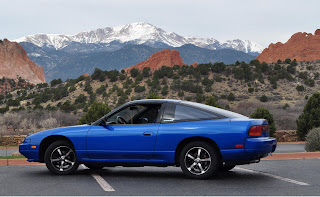 as a side note you can see the kissing camels on the rock to the upper right hand side. (will get to that later).
I live not far from Garden of the Gods in Colorado Springs. It's a beautiful region with sedimentary beds of colored sandstones, conglomerates and limestone. They were deposited horizontally, that is no longer the case as they reach into the sky vertically.
Evidence of past aions; ancient seas, eroded ruminants of ancestral mountain ranges, alluvial fans, sandy beaches and great sand dune fields can be read in the rocks. But I just like it because it makes the rocks look like BACON!

I kid.
Here is a cross section of the park I drew for a college course. It shows how the different layers of rock bend towards the sky under Colorado Springs and form Garden of the Gods.

A spectacular shear fault can be observed where the Tower of Babel in the Lyons Sandstone where it contacts the Fountain Formation. Hmm Picture is missing I will go retake it and add it later.
The hogbacks, so named because they resemble the backs and spines of a pig, are ridges of sandstone whose layers are tilted. Instead of lying horizontally, some layers are even vertically oriented as mentioned above.
The Hogback says Oink Oink
Some hogbacks are several hundred feet long, and the tallest (North Gateway Rock) rises to a height of 320 feet. A notable rock feature on this hogback is Kissing Camels, it appears to be two very large camels sitting face to face with their lips touching it is also one of the most popular rock climbing spots in the city.
There are many fossils to be seen: marine forms, plant fossils, and some dinosaur fossils. But there is no such thing as Obsidian in Garden of the Gods:
On one occasion during the nineteenth century, Dr. George Frederick Kunz, vice-president of and "gem expert" of Tiffany & Co., wrote about a “specimen of obsidian” he was shown from the Garden of the Gods in Colorado. “A friend recently made a trip through parts of Colorado, and knowing our desire to obtain materials suitable for cutting into gems, he purchased at a pavilion, near the gateway of the Garden of the Gods, a specimen of what the dealer called “obsidian.” It was carefully packed and carried thousands of miles, and was handed to us with the ceremony befitting an elegant gift. We received it with much delight, and after removing yards of tissue paper, held it before a lamp light, and saw a transparent mass of about 4x4" of pure bottle green- glass.”
-Kunz, George Frederick. The Mineral Collector. Volume II, number 6, August 1895, page 97.
This does not mean you might not find obsidian shards or objects int he park. It is possible from an anthropological point of view that you may find man made objects transported into the park. Particularly but Native Americans. I would just be wary of buying any Colorado obsidian on the internet found in Garden of the Gods.
Trivia:
The name Colorado is said to come from the color of the red sandstone.
The name of the park dates back to August 1859 when two surveyors helping to set up nearby Colorado City were exploring the nearby areas. Upon discovering the site, one of the surveyors, M. S. Beach, suggested that it would be a "capital place for a beer garden." His companion, the young Rufus Cable, awestruck by the impressive rock formations, exclaimed, "Beer Garden! Why it is a fit place for the gods to assemble. We will call it the Garden of the Gods." The beer garden never materialized, but the name stuck.
In 2006 a dinosaur species discovered there, was named after the park: Theiophytalia kerri.
- Garden Of The Gods | Education | Park History http://www.gardenofgods.com/education/index_175.cfm
All Pictures Copyrighted Mehner Photo Illustrations and are the expressed property of Fred Mehner III
Next time you go to Garden of the Gods or visit it from out of state have a beer and remember you can learn a lot about the world while enjoying a cold brew.
Garden of the Gods is one of my favorite places to drive in Colorado. The first picture of the set is my car with Garden of the Gods and Pikes Peak in the back ground.

I live not far from Garden of the Gods in Colorado Springs. It's a beautiful region with sedimentary beds of colored sandstones, conglomerates and limestone. They were deposited horizontally, that is no longer the case as they reach into the sky vertically.

Evidence of past aions; ancient seas, eroded ruminants of ancestral mountain ranges, alluvial fans, sandy beaches and great sand dune fields can be read in the rocks. But I just like it because it makes the rocks look like BACON!

I kid.
Here is a cross section of the park I drew for a college course. It shows how the different layers of rock bend towards the sky under Colorado Springs and form Garden of the Gods.

A spectacular shear fault can be observed where the Tower of Babel in the Lyons Sandstone where it contacts the Fountain Formation. Hmm Picture is missing I will go retake it and add it later.
The hogbacks, so named because they resemble the backs and spines of a pig, are ridges of sandstone whose layers are tilted. Instead of lying horizontally, some layers are even vertically oriented as mentioned above.

The Hogback says Oink Oink
Some hogbacks are several hundred feet long, and the tallest (North Gateway Rock) rises to a height of 320 feet. A notable rock feature on this hogback is Kissing Camels, it appears to be two very large camels sitting face to face with their lips touching it is also one of the most popular rock climbing spots in the city.
There are many fossils to be seen: marine forms, plant fossils, and some dinosaur fossils. But there is no such thing as Obsidian in Garden of the Gods:
On one occasion during the nineteenth century, Dr. George Frederick Kunz, vice-president of and "gem expert" of Tiffany & Co., wrote about a “specimen of obsidian” he was shown from the Garden of the Gods in Colorado. “A friend recently made a trip through parts of Colorado, and knowing our desire to obtain materials suitable for cutting into gems, he purchased at a pavilion, near the gateway of the Garden of the Gods, a specimen of what the dealer called “obsidian.” It was carefully packed and carried thousands of miles, and was handed to us with the ceremony befitting an elegant gift. We received it with much delight, and after removing yards of tissue paper, held it before a lamp light, and saw a transparent mass of about 4x4" of pure bottle green- glass.”
-Kunz, George Frederick. The Mineral Collector. Volume II, number 6, August 1895, page 97.
This does not mean you might not find obsidian shards or objects int he park. It is possible from an anthropological point of view that you may find man made objects transported into the park. Particularly but Native Americans. I would just be wary of buying any Colorado obsidian on the internet found in Garden of the Gods.
Trivia:
The name Colorado is said to come from the color of the red sandstone.
The name of the park dates back to August 1859 when two surveyors helping to set up nearby Colorado City were exploring the nearby areas. Upon discovering the site, one of the surveyors, M. S. Beach, suggested that it would be a "capital place for a beer garden." His companion, the young Rufus Cable, awestruck by the impressive rock formations, exclaimed, "Beer Garden! Why it is a fit place for the gods to assemble. We will call it the Garden of the Gods." The beer garden never materialized, but the name stuck.
In 2006 a dinosaur species discovered there, was named after the park: Theiophytalia kerri.
- Garden Of The Gods | Education | Park History http://www.gardenofgods.com/education/index_175.cfm
All Pictures Copyrighted Mehner Photo Illustrations and are the expressed property of Fred Mehner III
Next time you go to Garden of the Gods or visit it from out of state have a beer and remember you can learn a lot about the world while enjoying a cold brew.
Wednesday, June 8, 2011
Welcome to The Colorado Geographer
As this blog was started late last night I have been debating what topic to cover first to start a theme. Rather than just reply to topics I find on the internet I figured I would kick of this blog with some photos of my home. So please enjoy these photos from around my home in Colorado. In the next few days I will talk about the region where I live and issues geography & geology could solve in my region.
 This was taken one nice day after a very long trip surveying the plant communities of Colorado back in 2009.
 This was taken by me Mothers day 2011 just south of Garden of the Gods at Red Rock Canyon Trail.
 Taken April 12 2010. A picture of Pikes Peak.
Well I hope you enjoyed. I'll Come back and talk to you soon about how each of these structures formed and how they effect the Colorado Springs Region.


Well I hope you enjoyed. I'll Come back and talk to you soon about how each of these structures formed and how they effect the Colorado Springs Region.
A reply to Sue L
This is a reply to Sue L's "Is America in 2011 comparable to Rome in 200AD – an advanced state of decadence? pcspeed.net The US has some serious serious problems. House prices have fallen by 33% and Unemployment remains high. 1 in 6 depend on food stamps to ensure they..."
Dear Sue L,
It is not likely America is facing the decline that Rome did. The USA may have bad spots when it deals with infrastructure but the majority is in working order. Our economic model and domestic trends maybe in flux, but the country could survive many disasters natural or manmade with hardship but it will not face a total collapse. The Idea that a society may fail do to Economy is highly over rated. Most advances in technology, social structure, and population growth happen after economic strife (and oddly times of war) and most nations fall from military conflict on their home turf. So I'll address the issues you mentioned rather than a lofty ideological commentary.
Housing prices falling 33% is not a sign of devalued homes, it is a sigh of price gauging coming to a decline. The value of a home should not be dictated by the housing authority or government agency, but by the consumers demand. A 33% decline is a reflection of consumers dissatisfaction with housing monopolies.
Food stamps and Unemployment are related so please consider this: 1 in 6 households have food stamps because food is being produced inefficiently. In Colorado (an arid plain/desert) water is wasting growing Cotton (a more profitable commodity then food) and food is shipped from Mexico to CO. This is a highly inefficient way to run agriculture, water and oil/coal resources. Furthermore, minimum wage is not a living wage. The higher the cost of food the higher cost of living and thus the higher cost of all products in industry. Agriculture needs to become a staple of American life, rather being the small farm, the community garden, or the super science hydroponic genetically grown. One way to supply more jobs in the economy is better use of resources and increase in food production jobs. However Unemployment remains high bouncing between 8 and 10% because CEO's take a disproportionate pieces of company wealth ( don't take my word for it http://money.cnn.com/2007/08/28/news/economy/ceo_pay_workers/index.htm). There is a shrinking middle class in America do highly to a "1 2 punch" :
The First Punch: Companies are allowing themselves to be fleeced by CEO's/Unions/And trust funds while not reinvesting in strong middle management growth and valuable employment. I submit to you the following link. It is a Map that will show that the lowest unemployment rates are in agricultural areas (3-4%) and oil rich areas at (5%) While areas subject to urban sprawl (or service based fields) are reaching 10-26% highs. ( the Maps link http://www.nytimes.com/interactive/2009/03/03/us/20090303_LEONHARDT.html )
The Second Punch: American's as a whole feel entitled to lifestyles of the rich & famous without means. I am not saying I don't want a sports car that runs on magic, or a plasma TV the size of my wall, or even a dirigible in my front yard. I do! But Let's be realistic. These are not commodities' that I am entitled too. If I want them, I can work for them, buy them, or build them. But it is not entitled to me because I see Smith down the street has it. Some peoples priorities need to be put in check. 400 channels of Cable TV is not worth giving up food on my table. Just because someone has something doesn't mean I have to have it too. "The Keeping up with the Smiths (or Kardashian) lifestyle"(or Celebrititis as I like to call it) needs a serious kick to the curb. The American family/individual like corporations needs to reinvest in its growth and development and not get side tracked by the latest bell and whistle.
I digress, while these are a sign of a decadent society it is not a culture ending trend. The trends can be reversed by strong company's remolding their corporate structure, a serious investment into agriculture and energy markets, and a treatment for celebrititis. You might see new states, or fewer states in the American future. But the culture will endure. I mean After all Rome is still there it just changed. I look forward to your thoughts.
Dear Sue L,
It is not likely America is facing the decline that Rome did. The USA may have bad spots when it deals with infrastructure but the majority is in working order. Our economic model and domestic trends maybe in flux, but the country could survive many disasters natural or manmade with hardship but it will not face a total collapse. The Idea that a society may fail do to Economy is highly over rated. Most advances in technology, social structure, and population growth happen after economic strife (and oddly times of war) and most nations fall from military conflict on their home turf. So I'll address the issues you mentioned rather than a lofty ideological commentary.
Housing prices falling 33% is not a sign of devalued homes, it is a sigh of price gauging coming to a decline. The value of a home should not be dictated by the housing authority or government agency, but by the consumers demand. A 33% decline is a reflection of consumers dissatisfaction with housing monopolies.
Food stamps and Unemployment are related so please consider this: 1 in 6 households have food stamps because food is being produced inefficiently. In Colorado (an arid plain/desert) water is wasting growing Cotton (a more profitable commodity then food) and food is shipped from Mexico to CO. This is a highly inefficient way to run agriculture, water and oil/coal resources. Furthermore, minimum wage is not a living wage. The higher the cost of food the higher cost of living and thus the higher cost of all products in industry. Agriculture needs to become a staple of American life, rather being the small farm, the community garden, or the super science hydroponic genetically grown. One way to supply more jobs in the economy is better use of resources and increase in food production jobs. However Unemployment remains high bouncing between 8 and 10% because CEO's take a disproportionate pieces of company wealth ( don't take my word for it http://money.cnn.com/2007/08/28/news/economy/ceo_pay_workers/index.htm). There is a shrinking middle class in America do highly to a "1 2 punch" :
The First Punch: Companies are allowing themselves to be fleeced by CEO's/Unions/And trust funds while not reinvesting in strong middle management growth and valuable employment. I submit to you the following link. It is a Map that will show that the lowest unemployment rates are in agricultural areas (3-4%) and oil rich areas at (5%) While areas subject to urban sprawl (or service based fields) are reaching 10-26% highs. ( the Maps link http://www.nytimes.com/interactive/2009/03/03/us/20090303_LEONHARDT.html )
The Second Punch: American's as a whole feel entitled to lifestyles of the rich & famous without means. I am not saying I don't want a sports car that runs on magic, or a plasma TV the size of my wall, or even a dirigible in my front yard. I do! But Let's be realistic. These are not commodities' that I am entitled too. If I want them, I can work for them, buy them, or build them. But it is not entitled to me because I see Smith down the street has it. Some peoples priorities need to be put in check. 400 channels of Cable TV is not worth giving up food on my table. Just because someone has something doesn't mean I have to have it too. "The Keeping up with the Smiths (or Kardashian) lifestyle"(or Celebrititis as I like to call it) needs a serious kick to the curb. The American family/individual like corporations needs to reinvest in its growth and development and not get side tracked by the latest bell and whistle.
I digress, while these are a sign of a decadent society it is not a culture ending trend. The trends can be reversed by strong company's remolding their corporate structure, a serious investment into agriculture and energy markets, and a treatment for celebrititis. You might see new states, or fewer states in the American future. But the culture will endure. I mean After all Rome is still there it just changed. I look forward to your thoughts.
Subscribe to:
Posts (Atom)