The Spanish Peaks

The Spanish Peaks
From a Survey of Colorado's Plant Communities
Showing posts with label Colorado. Show all posts

Tuesday, December 6, 2011

Baculite Mesa

Recently I was invited out to Baculite Mesa, CO, to go play around in the clays and sandstones with my alma mater and the new class of budding geoscientist. The location was on private property but thanks to the college professor arrangements to dig on the property were easily arranged. 

As a side note:  A lot of the fossils we found can be located 2miles or so East of  I-25 in Pueblo but there is a lot of farm and private property so pay attention to no trespassing signs.

For the dig site we were at you can use your hands to dig in the regolith and soils.  Gloves are needed, but a spade(shovel) or a small rock pick are a nice advantage.  Having been to the location before I knew I wanted a pic to break up some of the larger conglomerates.


My new rock pick is actually a 22 inch concrete buster found at my local hardware store for a little under $30.

 What we were looking for is what the mesa is famous for, Baculites.  Known as walking stick rocks, or those funny little elongated ovals found in dirt to amazed kids playing in mud.  Bacluites are actually ammonites with nearly straight shells.  They are similar to oval cones if your ever lucky to find one whole.  They are in the Molusk

The two I was happy to keep.
Baculites are found in the Mesozoic Era, specifically  the Late Cretaceous period.  The earth was warm and tropical.

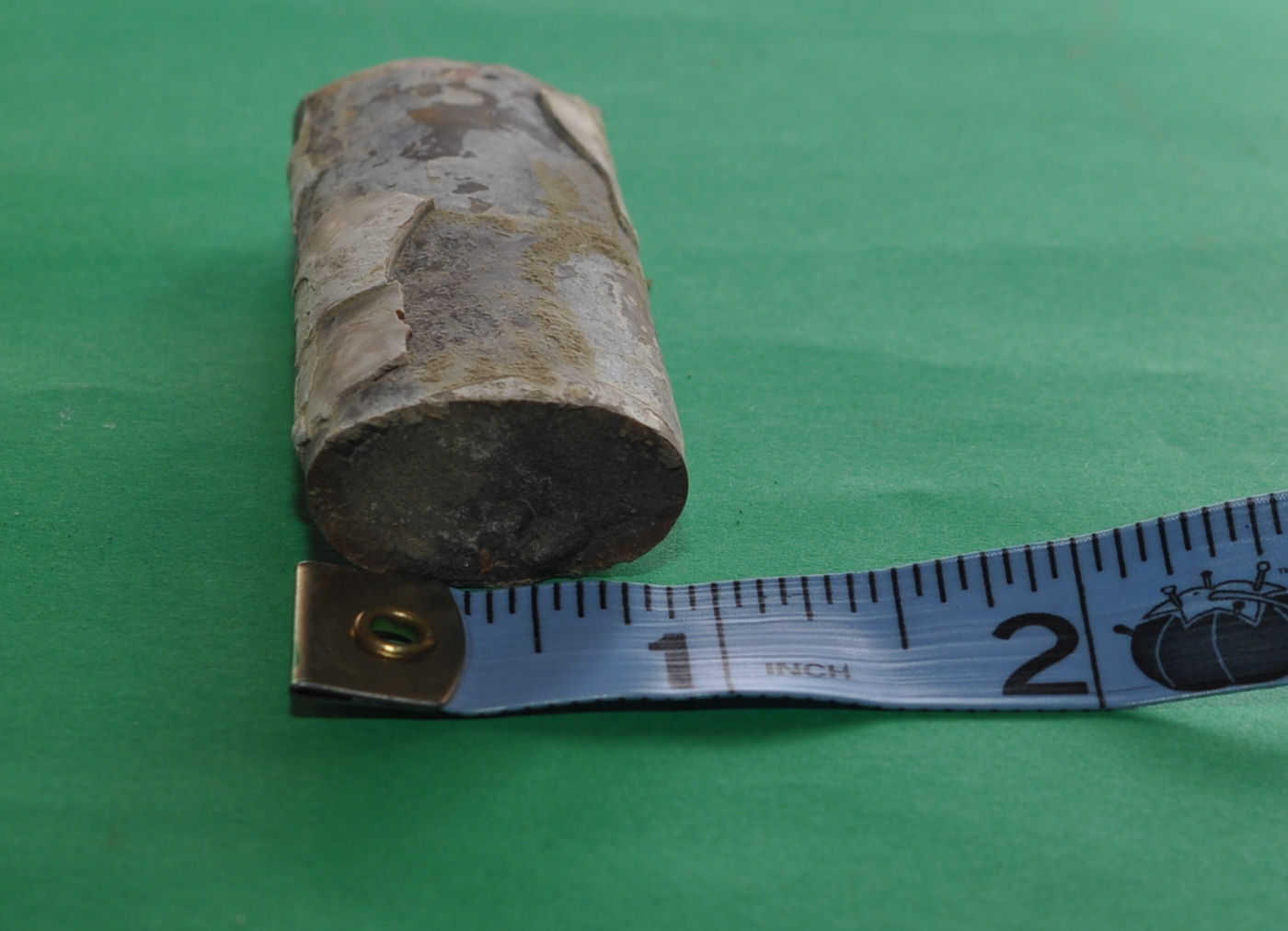
This Baculite is just over 3 inches in length. The pattern on the right of the Baculite is called sutures.
 In the above picture you can see sutures on the rock.  Sutures are the walls of the different chambers of the baculite.  Different sections of its segmented body. In the picture below you can see the telltale signs of the baculite, the oval shape of its bodies width.


Width just over 1 1/8 inch.
 Sometimes when finding baculites you will be lucky to find one with the nacre still attached.  The nacre is the baculites shell.  In the pictures below there is a yellowish/white surface chipped and broken along the fossil.  This is the nacre.  As you can see this fossil is very simular to the one above.  They are both baculites the following just has portions of its shell.  It is also a little smaller in measurements.  But a great find none-the-less because it has a portion of its nacre.


That is not all you can find in the Mesozoic.  I was lucky enough to find numerous bivalves and brachipods.  So yeah there are seashells in geology in the plains of Colorado. The difference between a bivalve and a brachiopod is very slight.  Brachiopods have had valves (shells) on the uper and lower surfaces, unlike the left and right arrangements in bivalves.  This is often differentiated
only by a toothed hinge.

This is a petri dish I use them to collect samples of similar fossils/rocks.  Any hard clear plastic case could work, like bottles or jars.  But avoid using glass.  As it will break. 

I liked this one the most.

Can you figure out if I am holding a bivalve or a brachiopod?


In the above picture is a Bivalve stuck in stone.  This thumbnail sized snack thrived in the marines of the ancient world (similar to species that thrive today in modern oceans and seas).  This one avoided being eaten only to be fossilized.

So why are fossils like this important to the world of science?
Well there are plenty of reasons, one you can produce a number of various chemicals out of their remains.  Calcium, Hydrogen, Carbons. You can date the strata (the layer of rock) you are digging in.
You can tell what the climate and environment was like in the region at the comparative date.

Why would any of that be important?
Well knowing what layer of rock your digging in will increase chances of knowing what can be discovered.  If I was looking for Dinosaurs this location would be the right peroid of geological time, BUT, Its aquatic, marine.   So its not likely to find land dwelling dinosaurs in a watery grave. 

Yet this does not mean I am not close. Often from sampling many areas that are marine you will often find shale or conglomerates.  These can indicate in which direction I would need to move to find solid dry land.  In this case, If I wanted a dino from this period of time, the evidence points that the land mass I want is in Utah.

Industrially however, there are other key implications the strata of this region can give away.  One is there is shale in the region.  Shale is a common component of paint, plastic, roofing materials, clays and bricks.  So manufactures of those supplies will be interested in the region.

Shale also helps make natural aquifers.  Aquifers are underground sources of water.  Often used in agriculture and housing developments.

One final note to touch on is, ancient marine regions are a great source of oils and natural gas. 

So to sum it up.  Knowing the strata of a region, by the fossil record and rock type can tell scientist what can be found in the region.  Shales to build from, oils and gas to power machines, water to drink, chemicals to use in modern industry, and the reason I like geo science, and probably the best reason, is I get to play in the dirt all day looking at fossils.

What little boy doesn't grow up wanting to do that. 


Wednesday, September 14, 2011

Colorado Weather, Hazards and Saftey in Extreme conditions.

The weather in Colorado is one of the factors that make the State thrive.  Tourism depends on nice weather and snow for the ski lifts.  Its "mostly sunny with a few clouds" almost 300 days of the year. It's the 65 days of the year that you have to worry about. 

Yesterday was 80-90 degrees and today it is raining.  The snow will be coming.  So let me welcome you to Colorado.  Where the Natives will tell you "If you don't like the weather, wait 15 minutes". 
Colorado Weather is no Joke.  In Single day it can go from 70 degree weather to blizzards to tornado's and thunderstorms.  It has happened more than once that  5 tornadoes touched down in Denver Metro area at the same time (http://www.thedenverchannel.com/news/19683459/detail.html).  The weather is fickle and dangerous.

·       So today I will suggest a Emergency road kit for your automobile, give you some safety tips for tornadoes and teach you about driving in the snow.


Emergency Road Kit:
I include this listen in all kits I build.  So first thing first.  Basic  survival is all about; water, food, shelter, warmth and signals.  The first 5 things on any emergency kit should be to facilitate these needs.
  1.    Bottled water (to rehydrate)
  2.     Granola or energy bars (to eat)
  3.    A Tarp (To stay dry outside a vehicle)
  4.     Blankets (to stay warm) 
  5.      a working flashlights (to signal other cars or see what you are doing)


Some of the basic items include and emergency kit are:

  • ·       12-foot jumper cables
  • ·       Four 15-minute roadside flares (signals) 
  • ·       Two quarts of oil

  • ·       Gallon of antifreeze
  • ·       First aid kit (including an assortment of bandages, gauze, adhesive tape, antiseptic cream, instant ice and heat compresses, scissors and aspirin)
  • ·       Extra fuses
  • ·       TOOLS: Flat head screwdrivers, Phillips head screwdrivers, Pliers, Vise Grips, Adjustable wrench
  • ·       Tire inflator (such as a Fix-A-Flat)
  • ·       Tire pressure gauge

It is also a very good idea to Bring along the following:
  • ·       Rags
  • ·       Roll of paper towels
  • ·       Roll of duct tape
  • ·       Spray bottle with washer fluid
  • ·       Pocketknife
  • ·       Ice scraper
  • ·       Pen and paper
  • ·       Help sign
  • ·       and heavy-duty nylon bag to carry it all in.


Tornadoes:  The Tornado Project does a great job on informing people about tornado saftey http://www.tornadoproject.com/safety/safety.htm

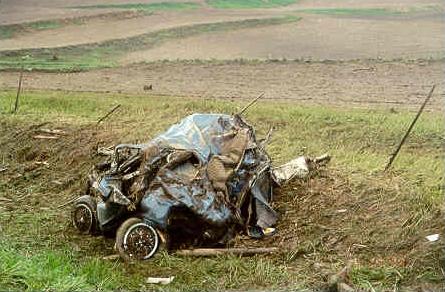
But a  few quick notes:  You car is not heavy enough to stop a tornado from lifting and throwing it. 

"In a car or truck: Vehicles are extremely dangerous in a tornado. If the tornado is visible, far away, and the traffic is light, you may be able to drive out of its path by moving at right angles to the tornado. Otherwise, park the car as quickly and safely as possible -- out of the traffic lanes. [It is safer to get the car out of mud later if necessary than to cause a crash.] Get out and seek shelter in a sturdy building. If in the open country, run to low ground away from any cars (which may roll over on you). Lie flat and face-down, protecting the back of your head with your arms. Avoid seeking shelter under bridges, which can create deadly traffic hazards while offering little protection against flying debris." Roger Edwards,  Storm Prediction Center, Norman, Oklahoma

One thing I would like to add is small drainage ditches are dangerous do to flash flooding don't take shelter in them from a tornado. 

Just stick to sturdy buildings and low lands in the valley between hills.


Driving in the Snow: 
Note Front will drive and 4 will drive will not make you a safer driver.   Only diligent attention to detail and cautious driving will help prevent snow accidents.  Watch all these Colorado Drivers try to surmount a small hill during a light blizzard. http://www.youtube.com/watch?v=qJFMywIKzSI

They all thought their car was able to make it, front wheel drive, 4wheel, light, heavy none of these cars where equipped for snow driving.  No Snow chains where used, the roads where not salted.  Each and every driver said to themselves "I can make it, these other idiots just don't know how to drive in the snow."  and each and every one of them made the same mistake.  They did observe what was going on, and they didn't know how to drive.

So tips for drivers in any car in the snow:
·       Observe: Pay attention to the driving and others around you.  Don't play with the radio, heater, cell phone while the car is moving.
·       If you see someone lose traction avoid repeating their mistakes.  If going uphill they tapped their breaks and then slid off.  Don't tap your breaks OR better yet plan a route with a lower grade hill.
  1. ·       If your rear end slides, Turn into the skid
  2. ·       If your front end slides, take your foot off the gas and go to neutral, don't break.
  3. ·       Move slowly with purpose.  Speed only accelerates the chance of accidents. More gas does nothing to stop your lack of control and only complicates things when you regain traction.
  4. ·       The Brake only stops tires not tires sliding on ice.
  5. ·       4wheel, AWD, only help you keep moving and only then when they have traction.
  6. ·       Front wheel drive, gives great forward traction and steering but avoid fishtailing the car.
  7. ·       Rear wheel drive:  DON"T DRIVE!  Your car is not built for control or traction, its built for speed.  It is not going to have any control because your front tires are now ice skates and your rear tires are going to spin at different speeds. So you have very little control.  Get a ride, wait for the storm to settle, get a taxi.  Avoid driving Rear wheel drive cars in the snow. 

The writers at Syracuse.com suggest the following.
"Despite a popular misconception, the best approach to recovering from a skid is the   same   for front and rear-wheel drive vehicles. If your  rear wheels  start to skid:
·       Turn the steering wheel in the direction you want the front wheels to go. If your rear wheels are sliding left, steer left. If they're sliding right, steer right.
·       If your rear wheels start sliding the other way as you recover, ease the steering wheel toward that side. You might have to steer left and right a few times to get your vehicle completely under control.
·       If your car has an anti-lock braking system (ABS), keep your foot on the pedal. If not, pump the pedal gently, pumping more rapidly as your car slows down. Braking hard with non-anti-lock brakes will make the skid worse.
  If your   front wheels   skid:
·       Take your foot off the gas and shift to neutral, but   don't   try to steer immediately.
·       As the wheels skid sideways, they will slow the vehicle and traction will return. As it does, steer in the direction you want to go. Then put the transmission in "drive" or release the clutch, and accelerate gently. " 
Two more great sites for driving in the snow info:
Edmunds.com and these 2 articles:
            http://www.edmunds.com/car-safety/driving-on-snow-and-ice-10-safety-tips.html
            http://www.edmunds.com/how-to/how-to-drive-in-the-snow.html
Syracuse.com Article :
http://www.syracuse.com/weather/snow/stories/driving.html

I hope this helps you have a safer driving experience in Colorado.  Enjoy your stay.  Drive like you know what you are doing, slow and purposeful.